
Editors’ note:
Well, it’s the end of this ambitious (and successful) city-wide event and although we were a little quiet about the whole thing for a while (stupid dissertations…), we took several tips to the venues (including the Art Crawl – a testimonial on Thursday) and we all ended up disagreeing in what is “art” and what is a haphazardly collected gathering of charity shop leftovers sticked together with Pritt Stick. But then again, art is always subjective. Without any further ado, here’s a short looking back we cajoled our “lowest in the food chain” writer to do. -M & Q.
Museums Sheffield: Millenium Gallery (Surrey Street)

The starting point for the whole experience of Art Sheffield, centred on how emotion affects us. Although it was a mixture of installations, multimedia and printed art, they all shared the underlying theme of emotion.
Shoum, by Katarina Zdjelar, is that all too familiar place I’ve been, trying to get down the lyrics of a song in a language I don’t completely master, but the feeling that a song can inspire in you and the dedication you give to dive a bit more into the song is perfectly reflected.
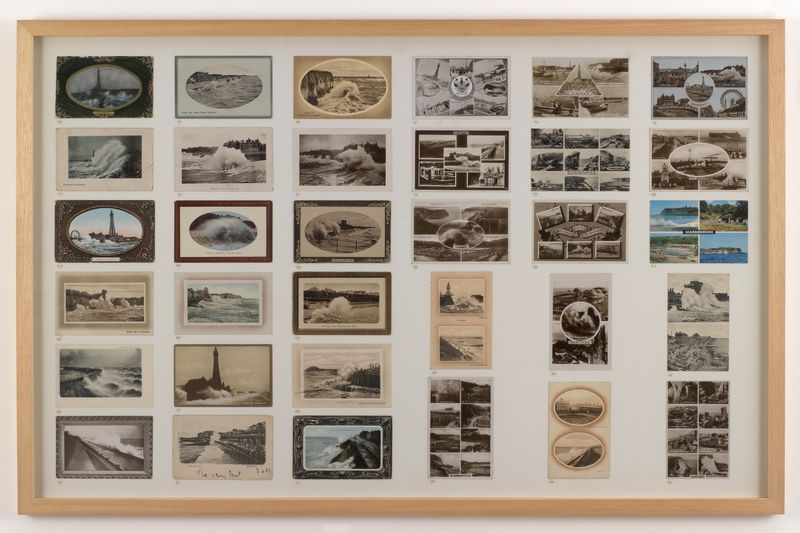
Speaking of diving, there was a massive collection (around 300) of postcards of stormy seas, categorised by Susan Hiller. The range of emotions you can get from simply watching how different artists tackle England’s beaches (and the mercurial weather) is simply amazing. They are only postcards but still, there’s something hiding in there, something only achieved by seeing all postcards as one chunk in a wall.
But me favourite still is Haroon Mirza’s strange, wonderful piece. I have no idea what it means nor what I should get from it, I just thought it was great and it made me wonder if it’s something Wiley E. Coyote would do if he stopped chasing that silly roadrunner.
Here’s what Mirza did: a television (with a video loop of birds flying) is at an equal distance of a bin (with some water spouting into a keyboard, shortcircuiting it). At another equal distance (or so) lies a projector. From time to time (it felt random, but maybe there’s more to it?) it all started to make some random noises. It was very Rube Goldberg-like.
S1 Artspace (Milton Street)

Just one installation here and it’s a bit strange. Several clothes racks, boxes, candles and fog machines were laid around, with a projector on the wall giving a bit of colour on the mostly sombre proceedings. There was an accompanying text, done by the artist itself, Haegue Yang.
Apparently it is based on the Korean myth of Dangun and the film Woman in the Dunes, and from what I could understand from the bizarre abstractedness is that sometimes you wonder if you work to live or live to work?
Bloc (Eyre lane)

And this is when it gets really abstract. Nina Canell’s art is only the one room, with an interesting chemical reaction happening in the middle (with some of the reactive dross flying and landing, creating a volcano like mound in the middle). A lonely lamp is on a corner, like a spoiled child. A fan is just doodling, idly. Does it mean anything? At first I was completely befuddled, until I went there again on the Art Crawl (more on that in Thursday’s post).
Sheffield Institute of Art & Design Gallery (Furnival Building, Arundel Street).

This is mostly video pieces and they seemed to be quite popular with the public. Heck, I know I really enjoyed all of them. From the funny/sad videos from Maud Haya Baviera (Happy and Summer wine) to the sad/sad/sweet of Katarina Zdjelar’s One or two songs, on someone or something
Persistence Works: Yorkshire Artspace Society (Brown Street)
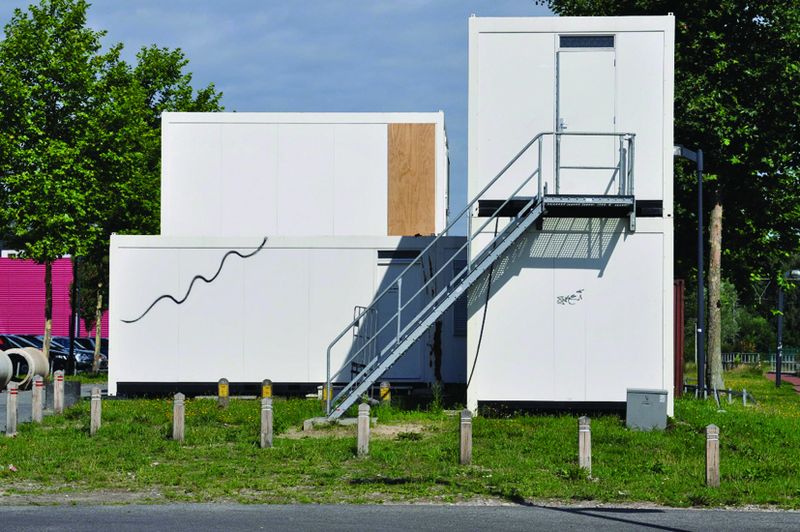
Even more abstract than the one at Bloc, Rachel Koolen’s Admin goes pomo is almost invisible. The chameleonic piece blends into the office and it speaks lots about it. On a personal note, I preferred Rachel Koolen’s recording about semiotics. An interesting take and what I liked best of this part of Art Sheffield 2010.
Site Gallery (Brown Street)

The last stop in my tour of Art Sheffield 2010, it felt like the perfect bookend to the exhibition in the Millenium Gallery. The obvious similarity is how it is a combination of multimedia and printed art, but the style is more off-kilter, which by no way implies that it’s not as artistic.
Two pieces caught my attention here. The first one was Yael Davids’ ‘The hand is quicker than the eye’ a film about prison inmates being taught magic tricks (except teletransportation, obviously). It’s all about the context on this one. Most tricks are about sleight of hand and maybe the whole thing is more about perception isolated in another environment?
My second fave piece was a display shelf with several copies of Robert Tressell’s ‘The ragged trousered philanthropist’. It’s a book that was edited (ok, chopped up is a more proper term) several times due to its socialist contents. Each copy, a different version, a different personality. Like the way we choose our own memories and we are defined.
And so that was Art Sheffield 2010. A broad spectrum of emotions, a complete smorgasbord of artistic techniques and here’s hoping for a 2011 edition.
—Sam
The author would like to thank Jo from Art Sheffield.

 Sloucher.org