

A clay-footed giant of the entertainment industry. A company that Kirby-gobbled everything around it and influenced pop-culture so much it still resonates to this day. An ill-fitting suit. A tough childhood spent in poverty, with not a single positive father figure in sight.
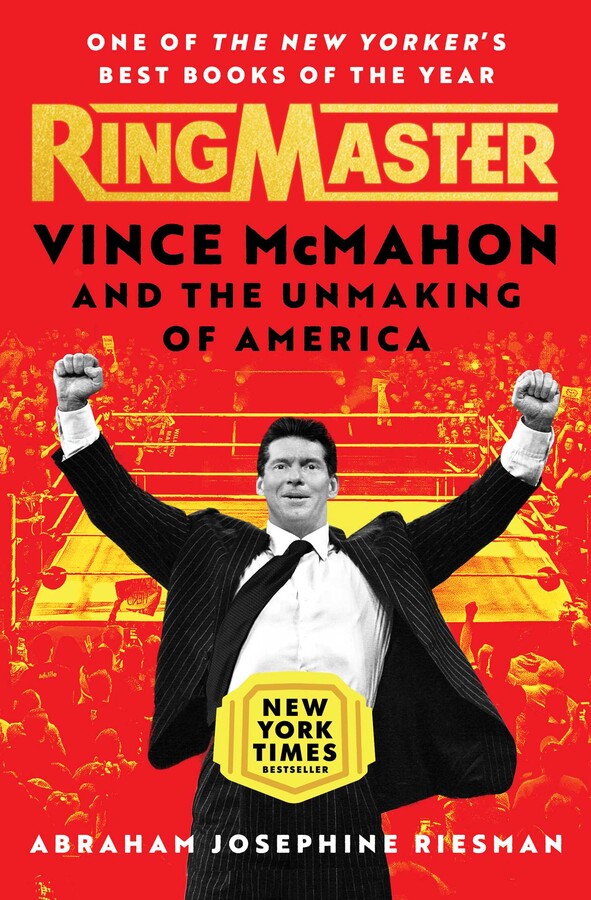
It’s hard summing up Josie Riesman‘s Ringmaster: Vince McMahon and the unmaking of America. It’s like a meal with so many ingredients, you can detect new spices and ingredients in every bite. Themes expand from rampant capitalism, aggressive companies, toxic masculinity, reality TV, the dangers of inflated egos, and, well, yes, Trump. The current US president never gets more than a few lines, but you fully understand his wanton desire for McMahon‘s fame. Once you understand how McMahon‘s playbook works like, you’ll understand Trump‘s too.

If we go for brass tacks, Ringmaster is a two-tiered criticism of both the dangers of seeking validation and not letting go grudges. For all his swagger, Vince McMahon is a frail person. Thanks to the cornucopia of references pulled by Riesman through her extensive investigative work, you can visualize McMahon‘s Rick Baker-like transformation from a nesh commentator into a hooded wheeler-dealer that connived many a entertainer of their money, their title or even their life.
The first section of the book, Part one: Faces,is the real meat and potatoes. Riesman‘s interviewing of anyone willing to talk about Vince‘s early years yields a beautiful landscape of how the schemer began his descent from an early age. As cunning as McMahon was, it’s a thin veneer; he just wants to impress his dad, the old school carnie selling wrestling to any rube willing to drop a few bucks for physical violence and subtle homoeroticism. Just like Jack Torrance, the madness was there, from the beginning, and no broken home fib can hide that this man was decisively conniving. The facade of camaraderie McMahon portrayed with his wrestlers was simply abuse, and no punches are pulled about it. All the abuse, trash bin hits, head shaving, and humiliating stunts McMahon puts himself into feel both like roleplay and a way to deal with his own issues. And the wrestlers? Sacrificing everything for “the business”, which, as the story progresses, starts to rhyme with “this thing of ours.”
Part two: turns documents how thoroughly the McMahons burrowed into politics. If you don’t harbor a massive dislike for Rick Santorum, this book will change that. It’s stunning how much wrestling permeated every moment, every aspect of US culture, until it was too late. The whole Attitude era surely broke the floodgates for NuMetal, a genre I enjoyed for a while, but now certainly regret. Many of the scummier McMahon actions, like the Montreal screwjob, are documented with such tact that even if you already know the outcome, still grips you.
That’s the magic of Ringmaster. You could wikipedia or, god forbid, chat gpt your way through the many scandals Vince McMahon incurred in, but it’s Riesman’s mighty pen, as sharp as she keeps it, what makes this facts hard hitting.
It’s a real flex to end the book on a particular meme-friendly point in Vince McMahon‘s life. It was frustrating at first, but it does bookend the book perfectly. By choosing the reveal of the greater power’s identity, the “it’s me, Austin, it was me all along” that lives rent-free in all of us, Riesman reveals the true villain in Vince McMahon‘s life: himself. The Rube-Goldberg contraption that caused his calamitous fall from grace was of his own invention.
Writing a hatchet job about any famous person is easy. Fun, too! People made careers out of it. This is as far as you can get from one. The amount of research and interviews that serve as the foundation for this book is granite solid, and in the end, this is more of a “these are the facts, take ’em as they are situation”. Just like Riesman‘s previous book, True Believer: The rise and fall of Stan Lee, and Juan Thompson‘s Stories I tell myself: Growing up with Hunter S. Thompson, the facts tell the story of flawed people who somehow manage to leave a mark larger than expected, and whose fame ended up destroying them.
-Sam J. Valdés López
Find more at Ringmaster: the book. There’s even a zine!

 Sloucher.org
One thought on “Review – Ringmaster: Vince McMahon and the unmaking of America”